English
Kargil, December 18, 2025
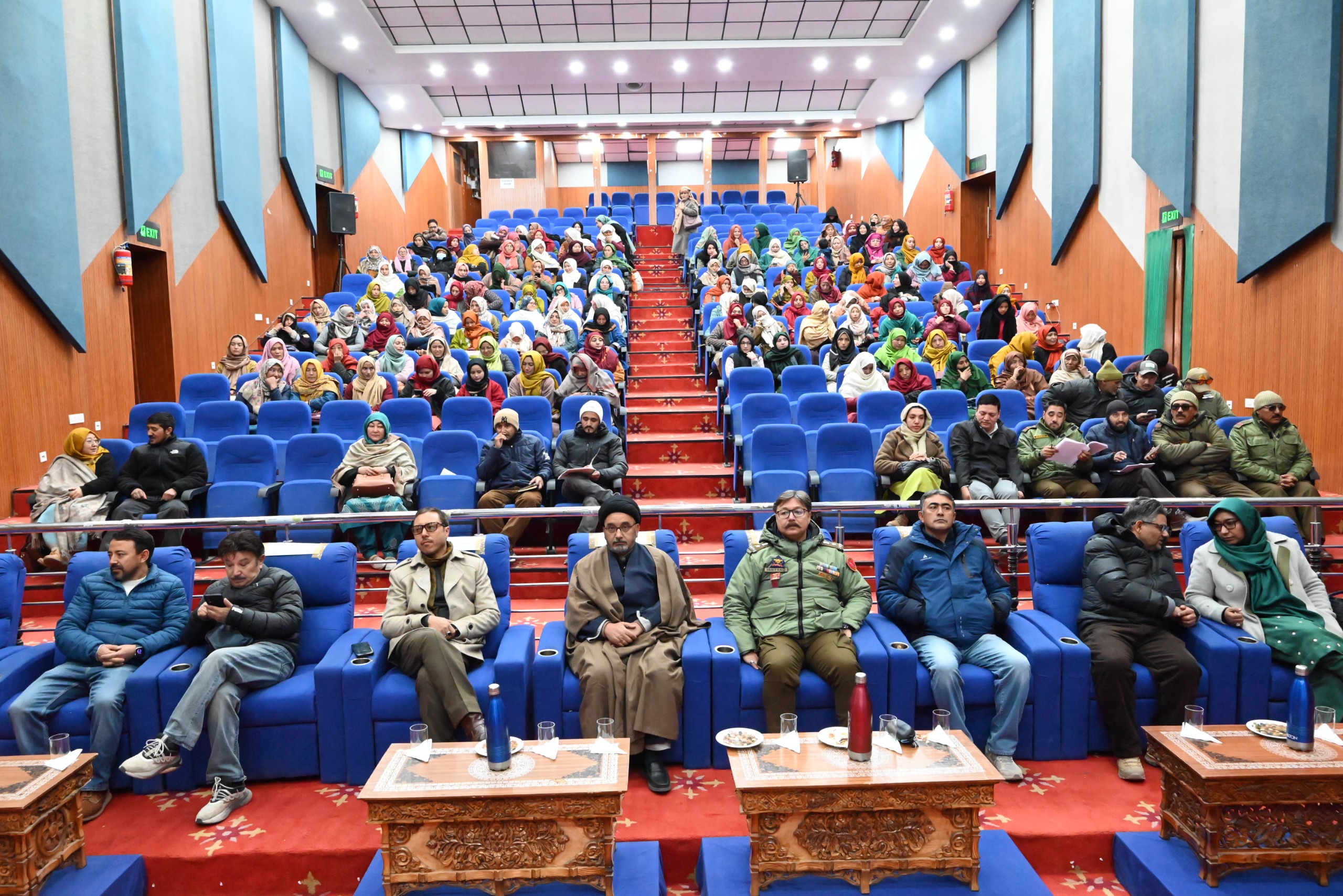
Ladakh Rural Livelihood Mission (LRLM) organised an event under the National Campaign on Gender Equality today at Syed Mehdi Memorial Hall, Kargil today. The programme was graced by Executive Councillor Aga Syed Mujtaba as the Chief Guest, Additional District Commissioner, Imteeaz Kacho as the Guest of Honour, and Superintendent of Police Kacho Ishtiyaq. Other dignitaries present on the occasion included Chief Medical Officer Kacho Liyakat Ali, District Panchayat Officer Raziya Khatoon, Councillor Khadim Hussain, General Manager DIC Shafiq Ahmad, senior officers from various departments, and Lakhpati Didis.
Executive Councillor Aga Syed Mujtaba, in his address, stated that discrimination between boys and girls is strictly prohibited in Islam, and that the Quran advocates equal opportunities for all. He remarked that women are not servants but a source of peace in society, and stressed the need to respect women and protect their rights at every level.
Guest of Honour Kacho Imteeaz thanked the organizers and appreciated the growing role of women in society, particularly the remarkable progress of Self-Help Groups (SHGs) in Kargil. He congratulated the women achievers and stated that listening to the speakers opened new perspectives on women’s roles and responsibilities. While acknowledging the increasing crimes against women, he also mentioned the importance of addressing misuse of legal provisions, stressing the need for fairness and balance. He beautifully quoted, “After returning from work, women again return to work,” highlighting women’s multitasking roles at home and in society. He further emphasized the need for self-defence training for women to safeguard their dignity and security, and thanked all dignitaries and participants.
Muneer Ahmad from NRLM briefed the gathering about the programme and stated that the objective of the campaign is to create awareness, especially among women, about self-reliance, dignity, and the need to prevent domestic violence. He emphasized that true equality must be ensured for all, and highlighted that Chaitanya 4.0 is being observed across the country to give voice to voiceless women.
Several guest speakers shared their views on gender-related challenges, incidents of violence, and ways to overcome them through awareness, education, and collective responsibility.
Abhishek Kumar spoke about the aim of the Chaitanya 4.0 National Campaign on Gender Equality, which is being observed nationwide from 25 November to 24 December. He highlighted that the campaign focuses on empowering women through education, skill development, and equal opportunities in all spheres of life.
Advocate Kacho Manzoor Khan from DLSA highlighted women’s equality from social, religious, and constitutional perspectives. He referred to the Preamble of the Constitution of India and Articles 14 and 15, which guarantee equality and protection to women. He assured that the District Legal Services Authority always stands in support of genuine victims of violence and remains committed to safeguarding women’s rights.
Sub-Inspector Nurboo informed the participants about procedures for filing genuine complaints related to domestic violence, including e-complaints, custody and safety measures, and confidentiality aspects concerning women.
Niyaz from CSW spoke on gender as a social construct and discussed common stereotypes practiced within families, such as associating specific colours, emotions, and behaviours with a particular gender. He emphasized that change must begin at home by rethinking language, behaviour, and the values imparted to children.
Assistant Professor Dr Imtiyaz, spokesperson from GDC and a psychologist by profession, stated that gender is largely a social concept rather than a biological one. He highlighted how societal norms often restrict women through expectations related to clothing, jewellery, tolerance, and loyalty, while excusing similar behaviour in men. He stressed that verbal abuse and eve-teasing must be addressed at the earliest stages, as neglect can lead to serious crimes. He emphasized the need for strong women’s representation and a change in societal attitudes towards gender equality.
The concluding session featured Fahmida, who expressed her thoughts through local folk poetry. Her powerful lines, “Tumne kaha tha hum ek hain, toh barabar kar do na” (You said we are equal, then make us equal), resonated deeply with the audience.
Overall, the programme proved to be meaningful and impactful, reinforcing the commitment towards women empowerment and contributing to the strengthening of an inclusive and equitable society.