हिंदी
हिंदी
Faster Approvals and Enhanced Data Security in Paperless Registration System
Five-Day Revert Time to be shorter; Documents to be Auto-Saved for 72 Hours and Fees to Remain Applicable until Completion
Help Desk in Every Tehsil for Citizen Assistance
Chandigarh, 13 November 2025
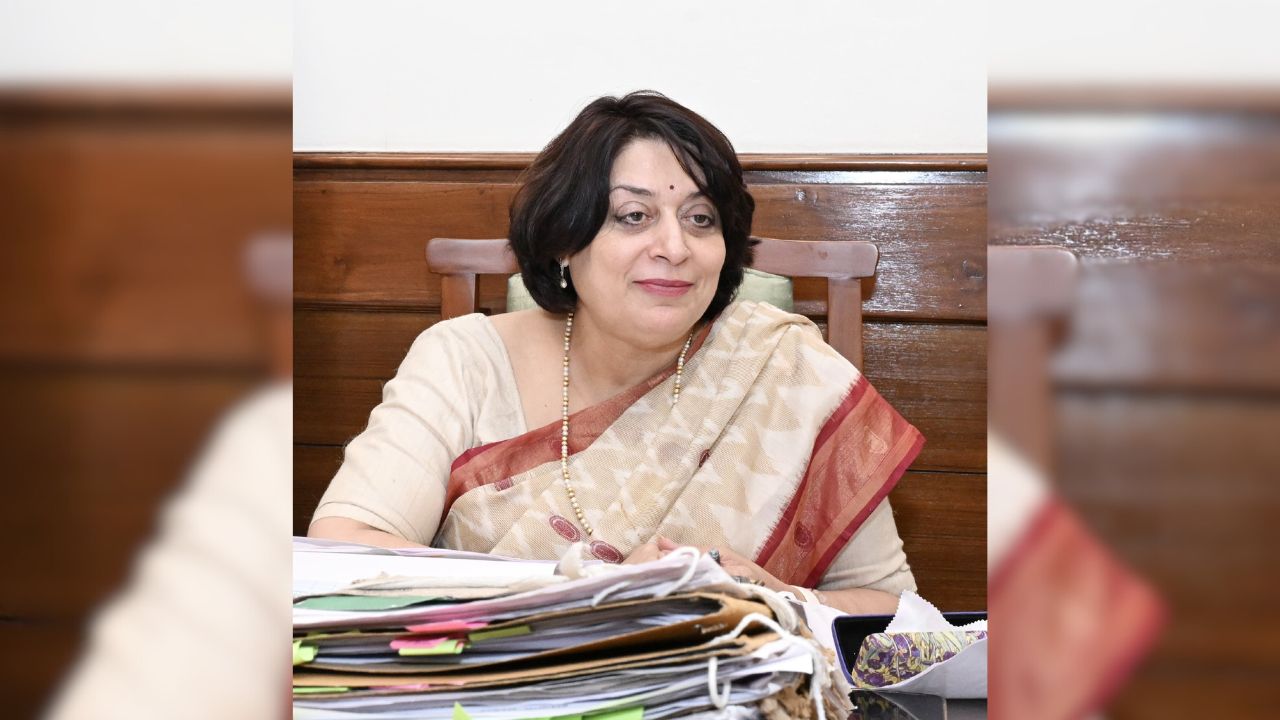
Financial Commissioner Revenue and Disaster Management, Dr. Sumita Misra, today chaired a detailed video conference with all Deputy Commissioners to review the progress and field-level functioning of Haryana’s Paperless Registration System.
Dr. Misra announced a series of major reforms aimed at enhancing efficiency and citizen convenience. She stated that the existing five-day revert time on applications would soon be shorter to expedite approvals and ensure faster service delivery. To safeguard data from accidental loss, all filled documents will now be automatically saved for 72 hours before deletion, while registration fees will remain applicable throughout the process until completion. She added that all issues flagged by Deputy Commissioners are being rectified in real time by the technical team. She also directed the establishment of dedicated help desks at every tehsil and the appointment of a nodal officer whose contact details must be made publicly available to assist citizens. Additionally, she instructed that a state-level helpline number be launched immediately to provide real-time support for citizens facing technical or procedural issues related to paperless registration.
Dr. Misra directed all DCs to ensure seamless internet connectivity at tehsil offices and to address server-related issues promptly. She emphasized that no technical or administrative bottleneck should be allowed to delay this transformative reform.
Calling the initiative “the biggest systemic change in Haryana’s revenue administration,” Dr. Misra said that any officer found obstructing or spreading misinformation against the reform would face immediate disciplinary action. She remarked that resistance to change is natural during major transitions, as was witnessed during the introduction of appointment-based registries and the Web-HARIS platform, but reiterated that the paperless registration reform is irreversible and represents a decisive step toward transparency and accountability.
To ensure smooth implementation, Dr. Misra directed all Deputy Commissioners to conduct regular hands-on training sessions for tehsil staff, Sub-Registrars, and deed writers so that every stakeholder is fully familiar with the new system.
Dr. Misra underscored the need for comprehensive public outreach to educate citizens about the functioning and benefits of the paperless registration system. She directed that all communication channels—print, electronic, and social media—be used effectively to spread accurate information, clarify misconceptions, and counter rumours. She emphasized that the success of this reform depends not only on technological readiness but also on citizen confidence and awareness.
Reviewing the performance data between November 1 and November 12, 2025, Dr. Misra shared that a total of 5,334 applications were received across the state, out of which 2,110 deeds were approved, 915 applications were under submission, 611 were approved by Sub-Registrars, and 626 were rejected due to documentation or technical errors. Additionally, 308 payments were processed online, 387 registrations were cancelled by citizens, and 377 cases fell under miscellaneous categories. When compared with the previous review period from September 29 to October 31, 2025—during which only 1,662 applications and 1,074 approvals were recorded—both applications and approvals have more than doubled, indicating a rapid adaptation to the digital platform.
Among the districts, Kurukshetra led with 810 applications and 524 approvals, followed by Mahendragarh with 428 applications and 205 approvals, Karnal with 409 applications and 208 approvals, and Jind with 384 applications and 131 approvals. Districts such as Faridabad, Gurugram, and Yamunanagar also reported steady growth, while Sirsa, Charkhi Dadri, and Panipat are expected to improve as familiarity with the new system increases. Dr. Misra pointed out that only seven out of the twelve review days were effective working days, as five were consumed by document approval processes, and observed that the system is now stabilizing across all tehsils.
Expressing concern over the spread of false information, Dr. Misra noted that some vested interests had circulated misleading claims that the paperless registration system had been shut down for ten days or that stamps purchased after November 1 would not be valid. She clarified that these were completely false rumours and that the system remained fully operational throughout the period. “These are baseless attempts to create confusion among citizens and deed writers,” she said, warning that strict action would be taken against those deliberately spreading such misinformation. She instructed all Deputy Commissioners to launch proactive awareness campaigns to counter such rumours effectively.
The document upload limit has been enhanced from 10 MB to 50 MB to accommodate more complex transactions. For government conveyance deeds, only the department name will be required, with no need to provide PAN or Aadhaar details. Mandatory Khasra or Killa entries have been removed for HSVP, HSIIDC, HSAMB, and Housing Board properties. The system now captures attendance automatically in GPA cases, supports multiple parties in a single transaction. NOC numbers will now automatically appear on deeds, and terms and conditions can extend up to 10,000 words. Furthermore, a Block Khasra Page has been introduced for officers’ convenience, and no physical documents will be demanded at the time of objections. In urban local body areas with a single owner, the ownership share is automatically treated as one-to-one, and the system dynamically defines the “first party” based on the type of deed—identifying the vendee as the first party in sale deeds and the principal in GPA cases.
Dr. Misra commended the proactive approach of district administrations and technical support teams in addressing on-ground challenges and maintaining continuous coordination. She expressed confidence that by the end of November 2025, the paperless registration system would be fully stabilized. “Haryana’s paperless registration initiative marks a major milestone in transparency, accountability, and citizen-centric governance,” she said. “This reform is transforming how property transactions are conducted, making Haryana a model for digital governance and administrative innovation for the rest of the country.” The review focused on assessing ground-level performance, resolving operational challenges, and ensuring that the system achieves full stabilization by the end of November 2025.