हिंदी
हिंदी

As many as 31 projects amounting to Rs. 256 crore approved for TWW, Chief Secretary
35 Micro Irrigation projects costing Rs. 206 crore approved
This year a total of 20274-acre feet of water released through Lal Bahadur Shastri Recharge Channel
District Water Conservation Plans formulated for all 22 districts
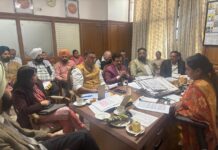
Chandigarh, March 25: Haryana Chief Secretary, Sh. Sanjeev Kaushal today assured the Union Ministry of Jal Shakti that the State Government will continue to make concerted efforts to sustainably manage groundwater resources.
Divulging the details about Haryana’s journey for Jal Shakti Abhiyan– Catch the Rain in synergy, during the meeting of Committee of Secretaries (CoS) on ‘Jal Shakti Abhiyan: Catch the Rain (JSA: CTR)-2022’ Campaign held through video conferencing today, Sh. Kaushal said that a 5 pillar Strategy including Institutional Reforms, Policy Interventions, focusing on key projects and activities, Convergence and Implementation and Governance has been adopted by the State.
The Chief Secretary said that the government of Haryana has been led from the front by Chief Minister, Sh. Manohar Lal himself and several Institutional and Policy initiatives were taken by the State for water conservation and management.
“Again leading from the front, the Chief Minister launched one of its kind Mera Pani Meri Virasat scheme, launched from eight districts even during the Pandemic.
During the meeting chaired by Cabinet Secretary, Sh. Rajiv Gauba, it was informed that the National Water Mission, Ministry of Jal Shakti will be implementing ‘Jal Shakti Abhiyan: Catch the Rain- 2022 covering both urban and rural areas of all districts of the Country. The campaign will be launched on March 29, 2022, and will continue till November 30, 2022. Secretaries of the following Central Departments, Ministries and Chief Secretaries, Administrators of States, UTs attended the meeting through video conferencing.
All 18,104 Ponds Geotagged
The Chief Secretary informed that since under the Jal Shakti Abhiyan geotagging of all water bodies was mandatory, therefore Ponds authority along with Haryana Space Applications Centre has geotagged 18,104 ponds, water bodies of the State, thereby making Haryana the only State to Geotag all its water bodies.
“With this, several MICADA schemes are catered to shift from flood irrigation to micro-irrigation to promote the saving of water. MICADA is targeting using Treated Waste Water (TWW) for agriculture and as many as 31 projects amounting to Rs. 256 crore have been approved covering 330 MLD,” informed the Chief Secretary.
35 Micro Irrigation projects costing Rs. 206 crore approved
The Chief Secretary further informed that as many as 35 Micro Irrigation NABARD projects amounting to Rs. 206 crore have been allotted covering 3127.27-hectare area. Besides this administrative approval to 56, Micro Irrigation works amount Rs. 300 crore covering 22941 area has also been given, he added.
Haryana turned crisis into opportunity with a focus on river rejuvenation and flood control
The Chief Secretary informed that during the current monsoon season, for the first time by drawing extra water for recharging from Jawahar Lal Nehru (JLN) Feeder sufficient water was released continuously in the recharge channel for recharging, thereby utilizing surplus water available during monsoon season.
“This year a total of 20274-acre feet water was released through Lal Bahadur Shastri Recharge Channel continuously for 67 days resulting into the filling of Reservouir upto the level of weir gauge 241.0 meter against designed 242.20 meter. This has benefited around 22 villages to improve the underground water table,” informed the Chief Secretary.
JSA CTR focused on saving and conserving rainwater in Haryana
The Chief Secretary shared that in Haryana, Jal Shakti Abhiyan’s (JSA) Catch the Rain (CTR) campaign is focused on saving and conserving rainwater. Realizing the same, as many as 49,136 rainwater harvesting structures, around 8623 renovations of traditional water bodies, 25,921 reuse and recharge and 6238 watershed development structures have been constructed across the State.
“District Water Conservation Plans has been formulated for all 22 districts. These plans are made from micro-level village plans and contain both supply and demand side interventions and strategic action plan for water conservation,” informed Sh. Kaushal.
Institutional Interventions
The Chief Secretary shared that several institutional reforms have been introduced to facilitate more structured water governance besides ensuring execution, evaluation and measurement of various schemes goals.
He further informed that the Haryana Water Resources Authority was constituted in 2020 for taking a holistic overview of Ground Water and Surface Water, for judicious, equitable and efficient use. Apart from this, Haryana Pond and Waste Water Management Authority (HPWWMA) have also been established to promote and monitor the development, protection, rejuvenation, conservation, construction and management of ponds.
“Micro Irrigation and Command Area Development Authority (MICADA) was constituted in the year 2020-21. Along with this, a mass awareness campaign under ‘Per Drop, More Crop’ is being run to enunciate the idea of saving water in the water-stressed areas,” said Sh. Sanjeev Kaushal.
Policy reforms
Sh. Sanjeev Kaushal informed that several policy reforms are taken up by the Haryana Government provide supplement efforts to the project and schemes and they act as guiding principles for implementation of schemes and projects.
He informed that ‘New Watercourse Policy-2021’ has been implemented for renovation, rehabilitation, reconstruction and expansion of watercourses for irrigation purposes.
“Under this Policy, installation of Micro Irrigation system has been made mandatory for availing new electricity connection for tube-wells in the area where Ground Water table is lower than 100 ft or 30 meters. Apart from this, administrative approval for as many as 43 works related to construction and rehabilitation amounting to Rs. 159 crore has been given”, said Sh. Kaushal.
Sh. Kaushal further informed that ‘Treated Waste Water Policy-2019’ has also been implemented by the State Government for envisaging maximizing the collection and treatment of sewage generated and reusing of Treated Waste Water on a sustainable basis, thereby reducing dependency on freshwater resources.
“While realizing that every drop counts, ‘Mera Pani Meri Virasat’, ‘Atal Bhujal Yojana’ have also been implemented by the State Government.
Additional Chief Secretary, Irrigation and Water Resources Department, Sh. Devender Singh also attended the meeting.