English
CHANDIGARH
There is an obvious but poorly understood connection between smoking and Buerger’s disease, also known as thromboangiitis obliterans. Without cigarette exposure, Buerger’s illness doesn’t actually develop. The distal medium-sized veins and arteries, particularly those close to the ankles and wrists, are impacted by Buerger’s disease. The condition is characterized by thrombotic obliterations that start distally and advance proximally. Segmental Buerger’s disease commonly affects blood vessel lengths of 5 to 10 cm. Collateral vessels that emerge as a result of arterial obliteration look as a “corkscrew” on an angiogram. In Buerger’s disease, vascular occlusion typically causes digit loss and, if smoking persists, significant tissue loss (e.g., hands or feet). Internal organ illness nearly never happens with Buerger’s disease, despite the fact that the extremities are significantly implicated.
What may result in Buerger’s disease?
The risk of acquiring Buerger disease is higher in heavy smokers. Additionally, it has been observed among marijuana and cigar smokers as well as users of smokeless tobacco, such as snuff and chewing tobacco. It is an uncommon condition, and the risk is lower in nations where cigarette usage has decreased.
What symptoms and indicators are present in Buerger’s disease?
Symptoms of Buerger illness include:
• Your lower legs or feet may feel achy, painful, or burn while you’re walking.
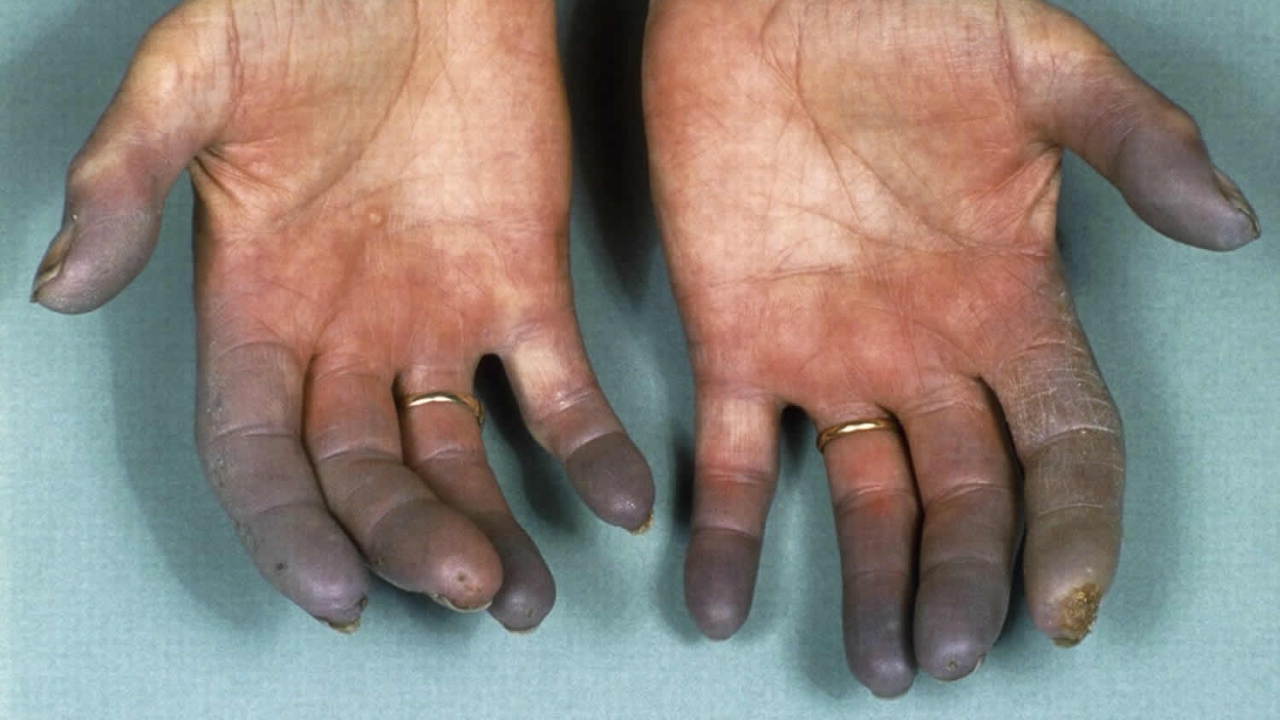
Clots in the blood, ulcers on the fingers and toes, a change in the color of the skin on the fingers and toes to pale, reddish, and occasionally bluish skin, and soreness or pain in the hands or forearms.
• Your lower legs or feet may feel achy, painful, or burn while you’re walking.
Clots in the blood, ulcers on the fingers and toes, a change in the color of the skin on the fingers and toes to pale, reddish, and occasionally bluish skin, and soreness or pain in the hands or forearms.
• Giving up all tobacco usage, including using electronic cigarettes.
• A procedure to provide blood to the injured tissues;
• A procedure to provide blood to the injured tissues;
• Additional procedures to cut nerves that travel to the tissue to alleviate pain or treat limb injury
• Some drugs aid in blood vessel relaxation and boost tissue blood flow.
• Some drugs aid in blood vessel relaxation and boost tissue blood flow.
Modernized therapeutic choices
• For many people, pain is a serious issue, and for some, it even interferes with sleep.
Radio-frequency ablation of the pain pathway in such people may result in symptomatic pain alleviation.
• Careful application of a laser to treat the ulcers
• However, the majority of the time, the only choice to avoid discomfort and ensuing gangrene is to amputate the finger, toe, or leg.