English
In the last 1 year, more than 3 Crore tap water connections given under Jal Jeevan Mission
As the Union government has been working towards making lives better for women across various sections by constructing individual household and community toilets, providing cooking gas, etc. similarly, tap water connections within the household aims to reduce drudgery and enhance ‘ease of living’ for young girls and women who are often burdened with the task of fetching water from the public standpost and walking long distances in search of water. By providing water at the doorstep, Jal Jeevan Mission is impacting the lives in multiple ways by improving the health parameters and reducing dropout from school among children.
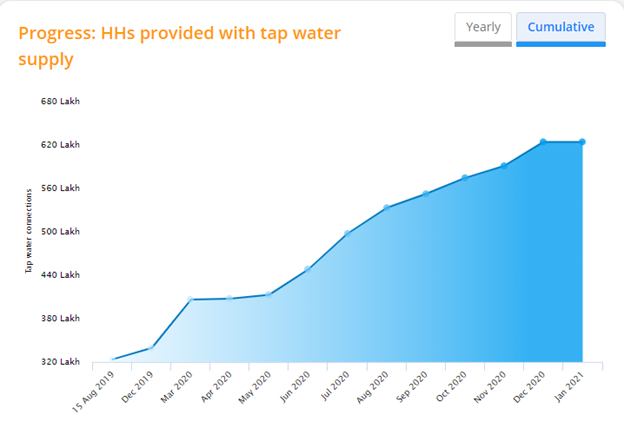
Progress of tap water supply in rural households since the launch of Mission
Household tap water connections – data as on 01.01.2021
Ensuring disease free life and holistic development of our children is a priority. In this spirit, a ‘100-Day Campaign’ was launched on 2nd October, 2020 to provide piped water supply to every school, anganwadicentre (AWC) and ashramshala, i.e. residential schools for children from tribal communities. Under this campaign, potable tap water will not only be available for drinking and cooking mid-day meals, but also for hand washing and running tap water in toilets.So far, in 3 months, more than 4.4 lakh rural schools and about 3.73 lakh AWCs have started getting potable tap water. Punjab and Tamil Nadu have become the first States to provide every school with tap water supply. Also, every AWC in Tamil Nadu is provided with tap water.
Consumption of contaminated water has adverse impact on our health, especially children. In this backdrop, upgradation of water quality testing laboratories and its accreditation from NABL have been taken up. There are about 2,300 water quality testing laboratories with States/ UTs and these have been opened up to general public, so that they can get their water samples tested at a nominal cost. Also, emphasis is given to empowering local village community to keep surveillance on quality of water supply and/ or source through regular testing using Field Test Kits (FTKs). A grand challenge is going on in partnership with the DPIIT to develop ‘portable domestic water quality testing devices’.
Under Jal Jeevan Mission, Village Action Plans (VAPs) for five years, co-terminus with the 15th Finance Commission are prepared so that fund available to PRIs can be gainfully utilized by GPs for assured water supply delivery to homes. These VAPs are aggregated at district level to formulate the District Action Plans (DAPs), which are consolidated at State level to formulate the State Action Plan (SAP). SAPcovers projects like regional water supply schemes, bulk water supply and distribution projects, etc. to ensure drinking water security in the State.The mission needs skilled human resources in areas like masonry, plumbing, fitting, electricals, pump mechanics, etc., in every village/ habitation, whose services will be used for creation of water supply schemes as well as regular O&M. Such a pool of skilled human resources in rural areas will make villages a self-reliant unit for regular upkeep and maintenance of water supply systems in line with idea ‘AtmaNirbhar Bharat’. This programme is to provide employment opportunities and boost local economy.
National Jal Jeevan Mission is assisting States/ UTs, which also include teams visiting villages to review the implementation and provide technical assistance to expedite the implementation with focus on prudent investment. The teams interact with members of GPs/ VWSCs and local community as well as PHED officials with focus on community participation and institutional arrangements for expeditious implementation. It is observed that local village communities, NGOs, SHGs, sector partners have joined hands to make Jal Jeevan Mission truly a ‘people’s programme’. The Mission is working on bringing about social and behavior change to ensure drinking water security.